Tax Reduction Strategies Worth Reviewing Before Year End
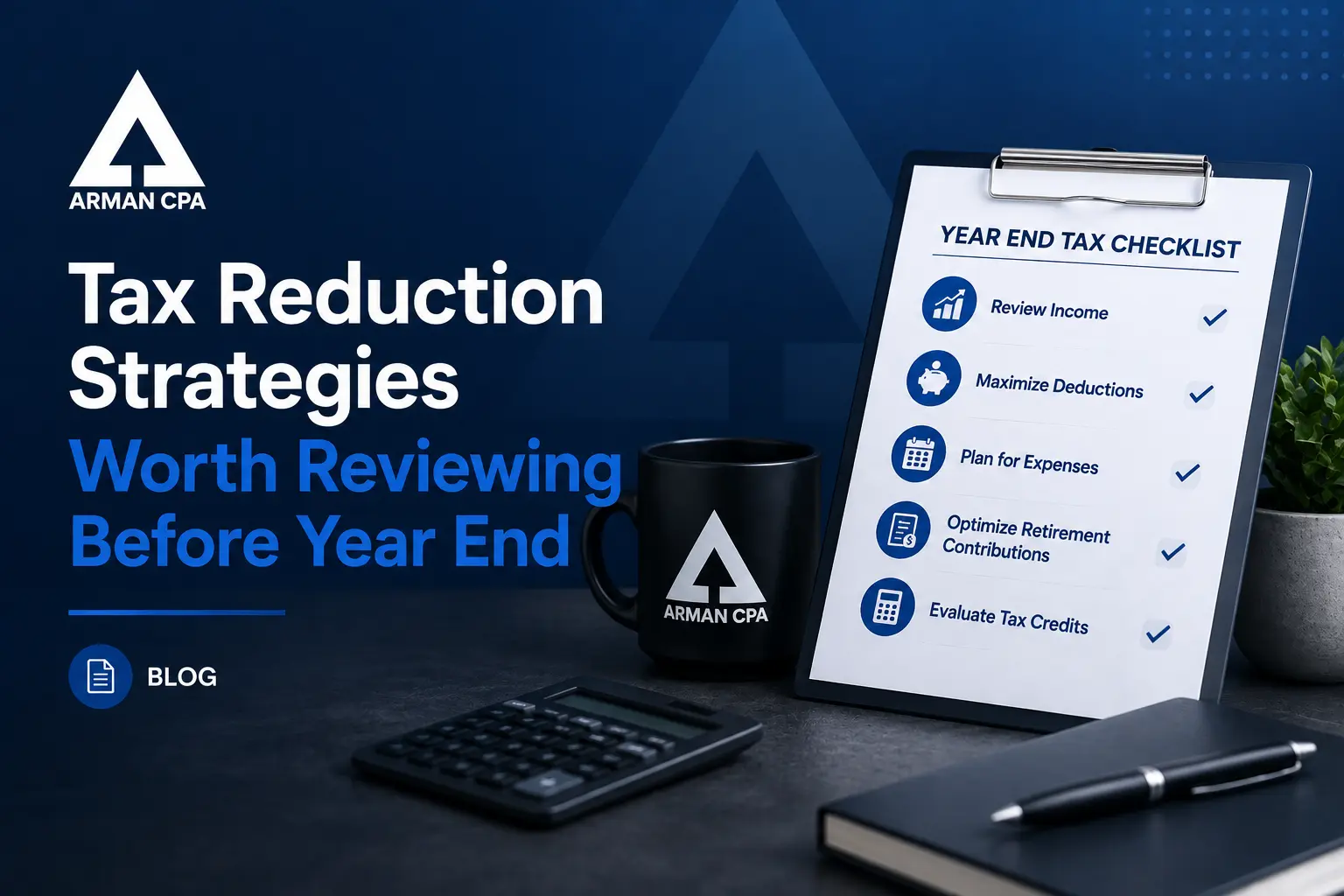
Reducing a tax bill legally comes down to a small set of levers used consistently: contributing to the right accounts, timing income and deductions, and structuring a business in a way that matches how it actually operates. None of these require aggressive planning. Most are available to any individual or small business owner who takes the time to use them.
This post covers the main strategies worth reviewing each year. It is general information, not advice tailored to a specific situation. A conversation with a CPA remains the right next step before acting on any of it.
Maximise retirement account contributions
Contributions to a traditional 401(k) or similar workplace plan reduce taxable income in the year they are made. For 2026, employees can contribute up to $24,500 to a 401(k), 403(b), or most 457 plans. Those aged 50 and over can add a catch-up contribution, bringing their total to $32,500. A higher catch-up applies to those aged 60 to 63, allowing total contributions of up to $35,750.
Traditional IRA contributions work the same way, though the limit is lower. For 2026, the IRA contribution limit rises to $7,500, with income-based rules determining how much of that is deductible.
Business owners without access to a workplace plan have their own options, including SEP IRAs and Solo 401(k)s, which allow considerably higher contribution levels than a standard IRA.
Use a health savings account, if eligible
For those enrolled in a high-deductible health plan, a health savings account offers a rare combination: contributions are deductible, growth is tax-free, and withdrawals for qualified medical expenses are also tax-free. For 2026, the contribution limit is $4,400 for self-only coverage and $8,750 for family coverage, with an additional $1,000 catch-up contribution available from age 55.
Unlike a flexible spending account, unused HSA funds carry forward indefinitely, which makes the account useful as a long-term savings vehicle as well as a way to cover near-term medical costs.
Time income and deductions deliberately
Income and deductible expenses do not always have to fall where they naturally would. A business expecting a lower income year ahead might accelerate deductible expenses into the current year. One expecting a higher tax bracket next year might instead defer certain deductions to offset income at a higher rate.
This applies on the individual side too. Bunching charitable donations into a single year, rather than spreading them evenly, can push total itemised deductions above the standard deduction threshold in that year, while taking the standard deduction in the years around it.
Review business deductions for underused options
Section 179 and bonus depreciation allow qualifying business equipment to be deducted in the year of purchase rather than depreciated over several years. This is worth reviewing whenever equipment purchases are planned, since the timing of the purchase can materially change the year in which the deduction lands.
Business owners who employ family members, including children working genuine roles in the business, may also find this reduces the family's overall tax burden, since income is shifted to a family member who may be taxed at a lower rate. This requires the work to be real and the pay reasonable for it, since the arrangement needs to hold up if reviewed.
Consider entity structure
The way a business is legally structured affects how its income is taxed. An S corporation election, for example, can reduce self-employment tax exposure for owners who take part of their income as a reasonable salary and part as a distribution. Whether this makes sense depends on the size and profitability of the business, and it is not a decision to make without reviewing the specific numbers first.
The strategies that matter most are the ones actually used
Most of what reduces a tax bill is not complicated. It is contributing consistently to the accounts available, reviewing deductions before year end rather than after, and keeping business structure aligned with how the business has grown. The strategies above are a starting point for that review, not a substitute for it.